
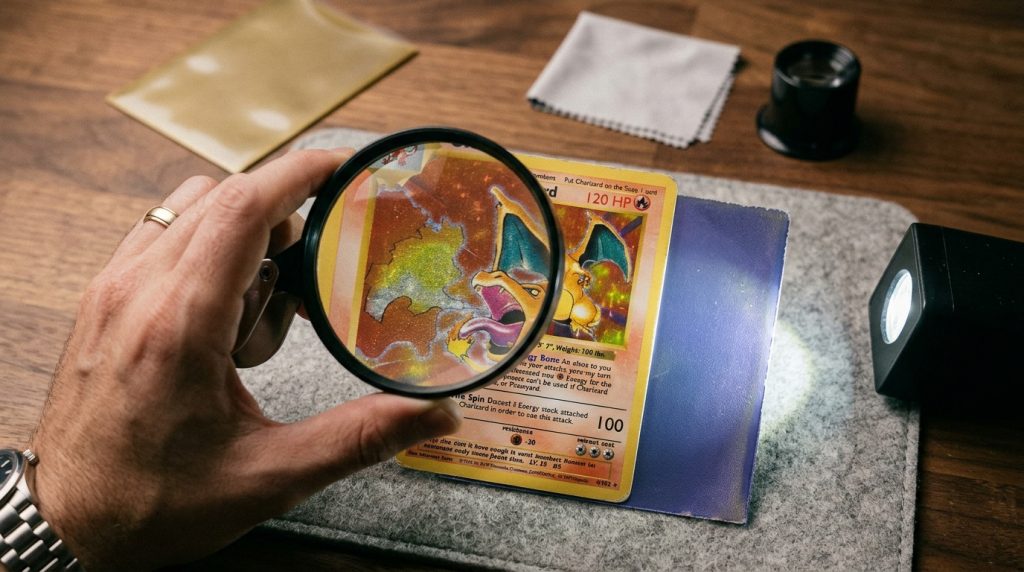
Print lines and edge whitening can reveal how Pokémon cards passed through printing, cutting, handling, and storage. These marks offer useful condition clues, but neither one proves authenticity alone.
A sound card inspection combines surface details with construction, printing patterns, color consistency, and comparison against verified cards. Understanding what each flaw can—and cannot—show helps collectors assess genuine cards without mistaking manufacturing variation for counterfeit evidence.
Print Lines and Pokémon Card Authenticity
Print lines appear as fine, straight marks across a card’s surface, often becoming clearer on reflective foil. Rollers or other production processes can leave these lines on genuine cards, so their presence does not automatically signal a fake.
Printing Patterns and Foil Lines
Examine the line under soft, angled light, then rotate the card. A genuine print line usually remains part of the foil’s surface appearance, rather than looking like a scratch that catches light differently.
Compare the card with a verified copy from the same set and printing. Genuine examples may share similar production marks, while counterfeit cards can show different textures, blurred artwork, or irregular printing patterns. However, counterfeiters can imitate isolated flaws, so one matching line cannot establish Pokémon card authenticity.
Edge Whitening and Card Condition
Edge whitening occurs when a card’s colored coating wears away and exposes its pale inner core. It often appears as tiny dots, a thin border line, or rough patches around corners.
Factory Marks and Handling Wear
Freshly opened cards can show slight whitening from cutting or production. Even, limited marks without other wear may suggest a factory origin, while uneven damage around frequently handled corners can indicate later friction.
Graders assess visible condition rather than assigning blame, so factory whitening can still affect a result. Dark borders make pale specks stand out, while heavy edge wear usually matters more than a few faint dots.
| Visible sign | Likely clue | What it cannot prove |
|---|---|---|
| Straight foil line | Possible production mark | Authenticity by itself |
| Even pale edge specks | Possible factory cutting wear | Exact production history |
| Uneven corner loss | Possible handling damage | Whether the card is genuine |
To reveal whitening, place the card on a dark, matte surface and use gentle light from the side. Check all four card edges, both faces, and each corner; a loupe or phone macro setting can expose tiny chips.

A practical inspection sequence keeps attention on the whole card rather than one conspicuous flaw:
- Compare front and back colors with a verified card from the same set.
- Inspect the card edges and corners against a dark background.
- Check foil texture, typography, symbols, and artwork details.
- Assess print lines alongside scratches, dents, and other wear.
Card Inspection Beyond Surface Defects
Surface marks help explain condition, but counterfeit detection requires several independent checks. A convincing fake may copy a familiar print line, while an authentic card may show unusual factory wear.
Construction, Color, and Grading
Check the card’s stock, edge layers, and overall feel against a known genuine example. Authentic cards typically show consistent construction; suspiciously flimsy stock, an unusual glossy finish, or a missing dark core deserves closer scrutiny.
Study color consistency, back artwork, fonts, symbols, and fine printing under magnification. Modern textured cards should display the expected embossed pattern, not merely a flat imitation. Verify the set name and card number through a reliable card catalog.
For valuable or uncertain cards, seek an experienced collector’s opinion or professional authentication. Trading card grading evaluates condition as well as authenticity, but grading cannot restore worn edges or erase print lines. A balanced review of construction and surface evidence gives each mark its proper weight.


