
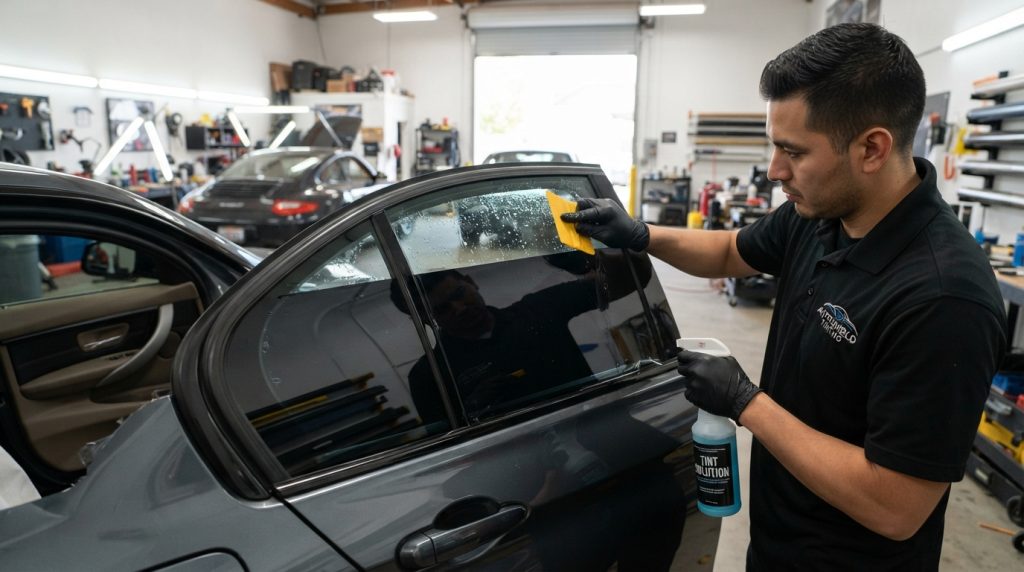
Choosing a window film is not simply a matter of making a car’s glass darker. Dyed, carbon and ceramic options differ in how they manage sunlight, heat, glare and ultraviolet exposure, and those differences affect comfort, visibility and the cabin’s long-term condition.
Film types in car window tinting
Car window tinting generally uses one of three film constructions: dyed, carbon or ceramic. All can reduce glare and alter the glass’s appearance, but they rely on different materials to control incoming sunlight.
A film’s visible darkness does not, by itself, show how much solar energy it blocks. Performance depends on the film’s composition and specifications, so product data is more informative than shade alone.
Dyed film characteristics
Dyed window film uses layers containing dye to absorb some sunlight. It is often chosen for its dark, uniform appearance and its ability to reduce glare, but its heat-control performance is typically more limited than that of advanced carbon or ceramic products.
Because the colour comes from dye, prolonged sun exposure can contribute to fading or a purplish cast in some films. Quality and installation influence how well a particular product holds up, making the manufacturer’s specifications worth checking.
Carbon film characteristics
Carbon window tint uses carbon particles to help block infrared energy and reduce solar heat entering the cabin. It generally maintains its colour more reliably than dyed film and creates a matte appearance that many drivers prefer.
Carbon films are non-metallic, so they are less likely than some metallic products to interfere with radio, GPS or mobile signals. Their performance varies, however, and a carbon label alone does not guarantee a particular level of heat rejection.
Ceramic film characteristics
Ceramic window film incorporates fine ceramic particles designed to filter substantial amounts of infrared energy while allowing visible light through. This can support strong heat rejection without requiring an especially dark shade.
Ceramic products are also non-metallic and generally avoid the signal interference associated with certain metal-based films. Their construction can make them a high-performance option, but product specifications and professional installation still determine the result.
Performance differences between tint films
Material is one part of the decision; the film’s measured performance is another. Comparing product data helps identify how well each option manages sunlight and what trade-offs to expect.
The following overview summarizes common tendencies rather than guarantees. Results vary by brand, film series, glass type and installation quality.
| Film type | Typical strengths | Points to consider |
|---|---|---|
| Dyed | Glare reduction and a dark appearance | Heat control and colour stability may be more limited |
| Carbon | Infrared reduction, colour stability and a non-metallic construction | Performance depends on the specific product’s ratings |
| Ceramic | Strong heat rejection and infrared blocking, often with good clarity | Specifications and installation quality remain important |
UV protection is available across many film categories, including products that are not especially dark. Since ultraviolet exposure can contribute to fading of upholstery and trim, a film’s stated UV-blocking performance matters as much as its appearance. More detail on this benefit appears in this overview of how window tint helps protect a car’s interior from UV damage.
Performance measures to compare
Before selecting a product, compare its published ratings rather than relying on broad category names. Useful specifications include visible light transmission, total solar energy rejected, infrared rejection and ultraviolet blocking.
These measures describe different properties. For instance, a high infrared-blocking figure does not necessarily mean the film blocks the same proportion of all solar energy, so matching the rating to the desired benefit gives a clearer picture.
Selection factors for a vehicle
Once the technical differences are clear, the choice comes down to priorities, glass characteristics and legal limits. A film that performs well on paper still needs to suit the vehicle and be installed correctly.
Several practical considerations can make the comparison more precise:
- Comfort: Consider how much heat reduction is desired, particularly for vehicles frequently parked in direct sunlight.
- Visibility: Choose a shade that preserves clear sightlines, especially at night and through the front windows.
- Signal reception: Non-metallic carbon and ceramic films are generally suitable where uninterrupted electronic signals are a concern.
- Appearance and longevity: Compare colour stability, finish and the product’s warranty rather than judging only by initial darkness.
- Local regulations: Check permitted tint levels for each window before installation, since requirements differ by location.
For a broader perspective on the benefits of professional automotive window tinting and interior protection, it is also helpful to distinguish cabin comfort from protection against UV-related fading. Neither replaces careful film selection or compliance with local rules.
Installation and long-term film care
Even a high-performing film can disappoint if it is poorly fitted. Dust, trapped moisture, uneven edges or unsuitable application can affect clarity and appearance, while incorrect cleaning may damage the surface.
Allow the film to cure according to the installer’s guidance, and use soft cloths with products approved for tinted glass. Avoid abrasive tools, which can scratch the film and shorten its useful life.
Tint durability depends on the film’s construction, exposure, care and installation. Dyed products may be more susceptible to visible fading, while carbon and ceramic films are often selected for colour stability; nevertheless, the maker’s warranty and technical details are the best guides for any individual product.
A careful window tint comparison weighs shade, heat rejection, UV protection, infrared blocking, signal interference and longevity together. For advice tailored to a specific vehicle and local requirements, consult a qualified window-film professional before choosing or installing a product.