

Glass door panels rely on more than clear sightlines and carefully chosen thickness. Their hardware openings, edge distances, and tempering sequence determine whether installers can fit each panel safely and accurately.
Because tempering locks a panel’s shape, teams need approved hardware details before fabrication begins. Understanding the limits helps buyers specify custom glass doors, reduce rework, and coordinate glass, hardware, and site requirements.
Tempering requirements for glass door panels
Tempered glass gains strength through controlled heating and rapid cooling. This process creates compression near the surfaces and tension within the core, improving impact resistance and breakage behavior.
Those internal stresses also make later cutting, drilling, or reshaping impractical. Fabricators therefore complete holes, notches, edgework, and other processing before tempering; a late change generally requires a replacement panel.
Stress and fabrication limits
Door hardware depends on precise interfaces. A misplaced handle hole can prevent assembly, while an incompatible patch fitting cutout can stop installation altogether. Even a small drawing error can make an otherwise finished panel unusable.
Set door panel thickness according to the application, hardware manufacturer’s requirements, panel size, and applicable safety glazing standards. Confirm glass type, finish, safety markings, and any project-specific compliance rules before production.
Edge clearance and opening placement
Hole position also affects stress around the opening. One published fabrication reference recommends an edge clearance of at least twice the glass thickness, measured from the glass edge to the hole edge.
For a hole near a corner, the same reference recommends a distance of at least 6.5 times the glass thickness from the corner tip to the nearest hole edge. Treat these figures as guidance, not universal approval; the fabricator must review the drawing, glass type, and applicable standards.
Hardware cutout dimensions and drawing approval
Once the panel’s basic specification is clear, hardware cutout dimensions need exact references. Approval should connect the hardware model, door orientation, glass geometry, and site conditions in one production document.
Hardware templates and door handing
Select hinges, handles, locks, patch fittings, and connectors before approving fabrication. Different product lines can use different hole patterns, so a general instruction such as “match the sample” leaves room for costly interpretation.
Show whether dimensions run from an edge to a hole center or use another datum. Mark the viewing side, hinge side, and door swing direction; left-hand and right-hand layouts can otherwise become confused across project teams.
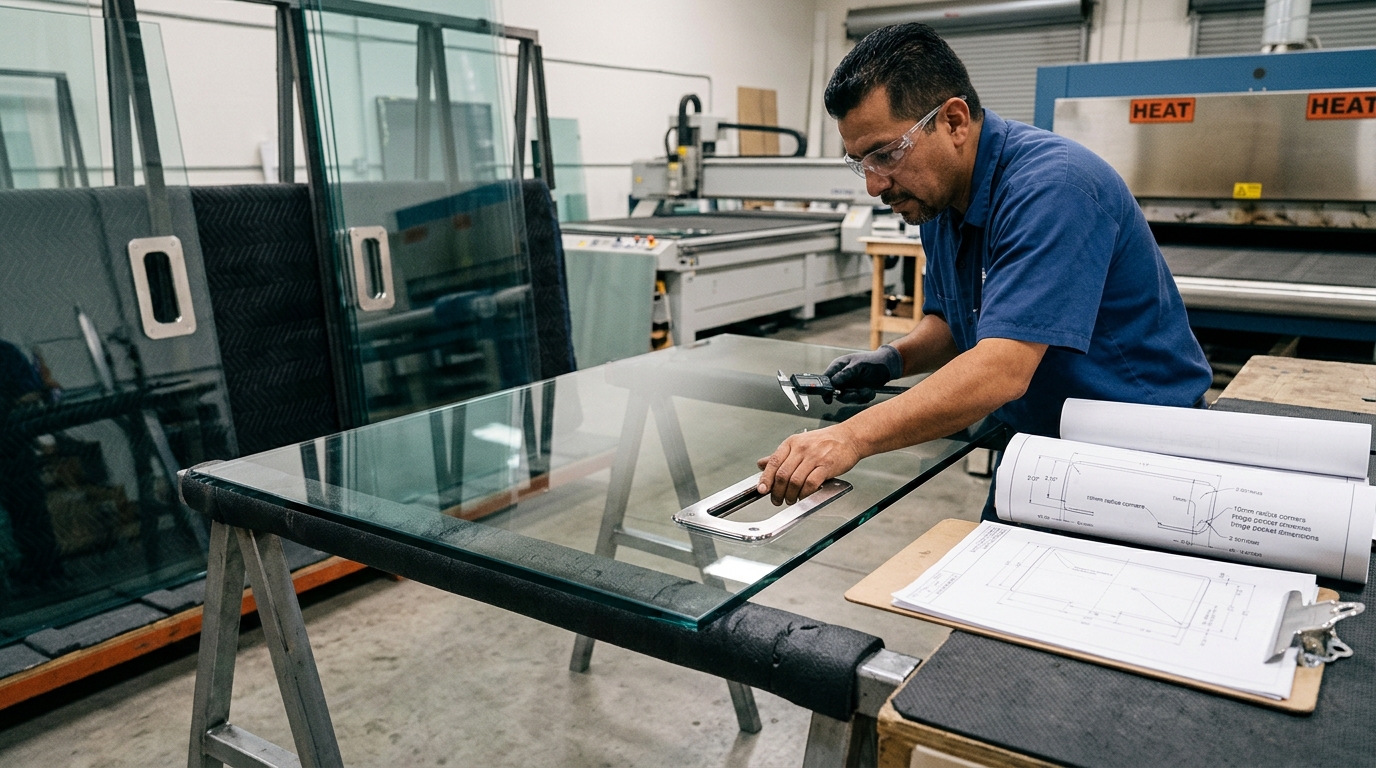
Before releasing the drawing, confirm these details with the hardware supplier and glass fabricator:
- Exact hardware brand, model, fixing method, and current drilling template.
- Panel width, height, thickness, edge finish, and required glass fabrication tolerances.
- Hole diameters, center coordinates, hinge cutouts, notches, corner treatments, and handle holes.
- Door handing, viewing direction, nearby frames, walls, and floor spring requirements.
- Glass type, tint, frosting, lamination, markings, and destination safety glazing standards.
Good hardware compatibility begins with a coordinated drawing, not a site adjustment. Tempered panels offer little scope for corrections after delivery, so resolve unclear dimensions before the factory starts work.
Shipping and installation coordination
Approved geometry matters, but so does receiving the right panels in usable condition. For imported orders, request clear panel labels, drawing references, protective separation, corner protection, and export crates suited to the shipment.
Ask how labels map to the approved drawings and how the supplier handles transit damage, missing pieces, or identification questions. These measures help installers sort panels and follow the planned installation sequence without unnecessary handling.
| Specification | Confirmation |
|---|---|
| Hardware | Model, template, and fixing method |
| Geometry | Panel size, holes, notches, and tolerances |
| Orientation | Viewing side, handing, and swing direction |
| Shipment | Labels, crate protection, and damage process |
With the drawing settled, verify that the final panel specification matches the selected use and hardware. Fabrication tolerances can vary by process and equipment, so the glass supplier should review project drawings before production.
Production checks for custom glass doors
Before approval, compare the hardware manufacturer’s template against the production drawing and confirm every reference dimension. Check edge finish, corner details, panel identification, and any required safety marks alongside the openings.
For unusual notches, large holes, or tight corner layouts, ask a qualified fabricator to assess feasibility. The team can review tolerances and suggest design adjustments before tempering fixes the panel geometry permanently.
When specifications align, installers receive panels designed for the selected hardware and site conditions. Consult a qualified glass professional and hardware supplier for project-specific review before releasing custom glass doors for fabrication.